The county where I live is adjacent to Lancaster County, PA, which is getting first-hand experience with how deadly measles can be. The recent “measles-associated” deaths of two infants there triggered an acrimonious exchange between RFK Jr and Pennsylvania’s Governor Josh Shapiro about whether or not people in the Commonwealth have died of the virus.
The two combatants did not discuss the role of Pennsylvania’s county coroners. As a former coroner and one who was in office during the COVID-19 pandemic, this politically-motivated conflict about vaccinations and counting deaths sounds familiar.
We knew little about Betacoronavirus pandemicum (aka SARS-CoV-2), the virus that causes COVID-19, in the early months of the pandemic. By way of contrast, Morbillivirus hominis, the virus that causes measles, has been plaguing humans for centuries. I’ll just call it the measles virus.
Maybe this is a good time to take a look at what we’ve learned about measles in all that time.
The virus
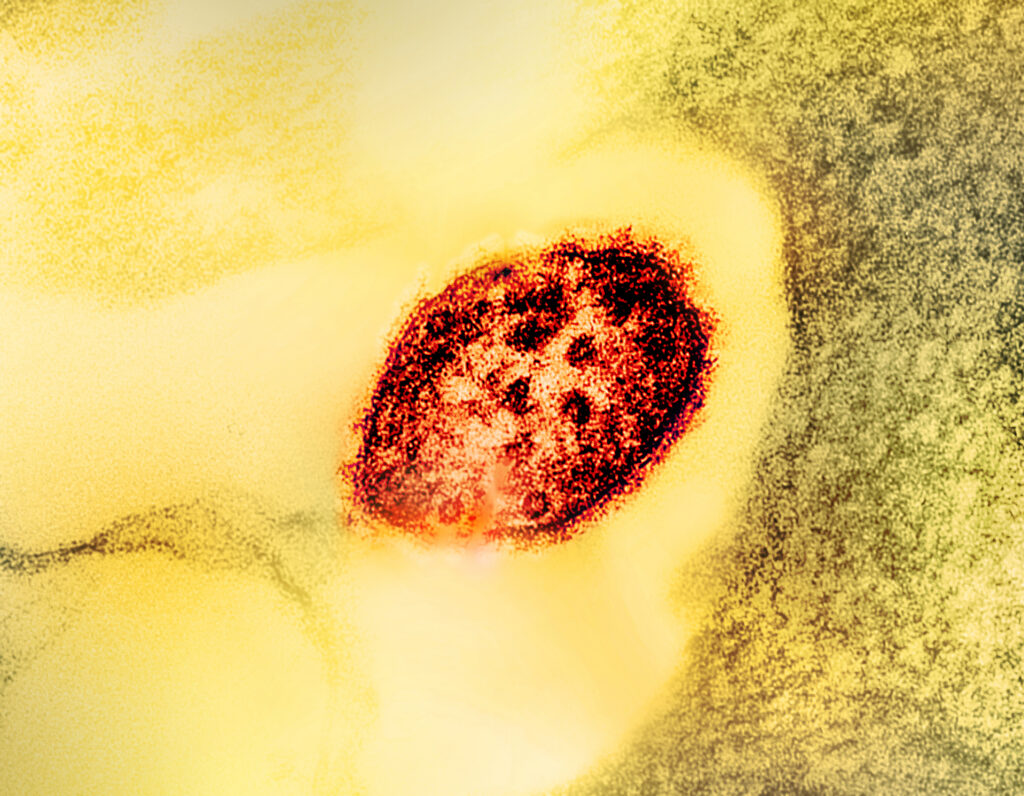
The measles virus, like SARS-CoV-2, is a single-stranded RNA virus, but it’s in a different virus family. Humans are the natural hosts of the measles virus. Unlike SARS-CoV-2, no animal reservoirs are known to exist.
Transmission between humans is primarily respiratory, with measles much more efficient at infecting people than SARS-CoV-2. The measles virus has a much smaller genome than SARS-CoV-2, but a polymerase has to convert it from negative-sense to positive-sense RNA before an infected human cell can replicate it.
How deadly is measles?
Most measles cases are self-limited and require only supportive care. But in 2024, according to the World Health Organization (WHO), there were “an estimated 95,000 measles deaths globally, mostly among unvaccinated or under vaccinated children under the age of 5 years.” That’s still less than the more than two million who died every year before Maurice Hilleman (see below) developed a vaccine.
On average, measles killed more than 400 people a year, mostly children, in the United States before the 1963 vaccine introduction.
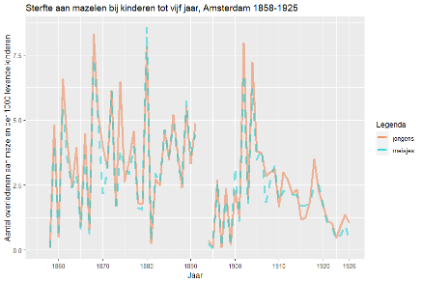
A team of university researchers in the Netherlands has a fascinating website page called “The stealth killer: measles deaths in Amsterdam” (page is in Dutch; my translation). “Stealth” because measles temporarily suppresses the immune system, making children susceptible to secondary diseases.
Approximately 9,500 persons, almost all young children, died of measles in Amsterdam from 1858 to 1925, usually during waves of outbreaks. The graph shows the number of deaths from measles in children under five years of age during that time.
In case you’re not fluent in Dutch, the y-axis shows the number of deaths per 1,000 children. jongens = boys, meisjes = girls. Not-so-fun fact: my mother’s cousin died of measles in the Netherlands in the early 20th century.
How does measles kill?
Most measles-related deaths are due to complications like pneumonia, encephalitis, dehydration, or virus-induced immune suppression.
Testing for measles
It’s not hard to clinically diagnose measles once the characteristic morbilliform rash appears and/or Koplik spots show up in the patient’s mouth.
If testing is necessary (say to determine a cause of death), the testing process is similar to what’s done for any viral respiratory disease (like COVID-19). A laboratory will perform polymerase chain reaction (PCR) test for the measles virus on a swabbed tissue or fluid sample.
An IgM test, which looks for recently produced antibodies to the measles virus, is also available, though less reliable than a PCR test.
The measles vaccine
Maurice Hilleman, a microbiologist with an interesting life story, developed many vaccines during his decades with Merck. The measles vaccine, first introduced in 1963, was one of his achievements.
In 2007, CDC researchers stated in a peer-reviewed medical journal that, after implementation of vaccines, “endemic transmission of poliovirus and measles and rubella viruses has been eliminated in the United States.”
Three FDA-approved vaccines protective against measles are available in the United States. All contain live, attenuated (weakened) virus. A CDC web page dated January 20, 2021 has details.
The do-not-vaccinate list
Note, this list may not be complete. Individuals should consult their health care provider before deciding for or against any vaccination.
Immunocompromised patients
A friend of mine takes medication that suppresses her immune system. Her doctor tested her and found she’s not immune to the measles virus (no significant IgG antibodies found). She can’t be given the MMR vaccine, because it contains live (though weakened) virus. She plans to stay away from Lancaster County or other measles hot spots for the time being.
Pregnant patients
The following information is from the American College of Obstetrics and Gynecology:
- MMR vaccination should not be administered during pregnancy
- Avoid pregnancy for 28 days after receipt of MMR
- gynecologists should discuss vaccination with all nonpregnant patients who don’t have evidence of immunity
- MMR can be given in the postpartum period even while breastfeeding
Congenital measles
This is currently an active medical concern in the United States. Indeed, the first measles-associated death reported in Pennsylvania this year appears to have been in a newborn who acquired measles in utero.
Please refer to the American Academy of Pediatrics recently posted Frequently Asked Questions about congenital measles. Here’s a snippet paraphrased from that website:
Congenital measles occurs when the fetus is exposed to measles through intrauterine transmission as a result of the virus circulating in the mother’s blood. Congenital measles was uncommon back when most pregnant women had been infected with measles during childhood. With the current outbreaks of measles, pregnant women who are not immune and haven’t been vaccinated can get sick and pass the virus on to a fetus or newborn.
Are N95 masks protective against the measles virus?
For those working with patients suspected or confirmed to have measles, the CDC recommends protection as least as effective as a “fit-tested, NIOSH-certified disposable N95 filtering facepiece respirator.” The CDC website last updated its guidance on measles for health care providers on August 19, 2025.
Still, we know the measles virus can linger in the air for up to two hours after an infected person vacates the space. Also, a person with measles can infect others for several days before the diagnosis becomes obvious. So unless you wear a fit-tested N95 mask everywhere, you may still be unknowingly exposed.
Are you immune to measles?
The CDC presumes you are immune if you:
- have had two doses of a measles-virus-containing vaccine
- have documentation of having had clinical measles
- have laboratory evidence of immunity (elevated titers of IgG antibodies against the measles virus)
- were born before 1957 (but consider vaccination if no other evidence of immunity)
If you were vaccinated for measles (two doses) or have had measles in the past, you will have IgG antibodies in your blood, usually for the rest of your life. An IgG antibody test can check for these antibodies in your blood. An elevated IgG titer means you likely are immune.
Good news: Just like there’s one vaccine for measles, mumps, and rubella, there’s one blood test that can screen for antibodies to all three viruses.
The measles outbreak in Pennsylvania
As of September 25, 2026, and despite an overall school-age vaccination rate of over 90%, the PA Department of Health reports 890 cases of measles in Pennsylvania this year.
Public health experts attribute the high prevalence of measles in Pennsylvania to the state’s large Amish population, most of whom live in Lancaster County. While the Amish and Mennonite populations don’t eschew vaccination per se, they have little contact with the health care system. Births and deaths often take place in the home, not a hospital.
How many people have died of measles in Pennsylvania?
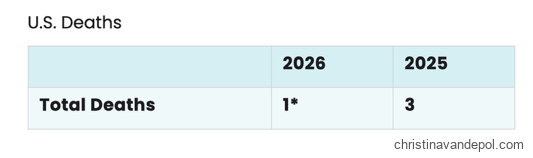
As of September 25, 2026 the CDC acknowledged one measles death in Pennsylvania.
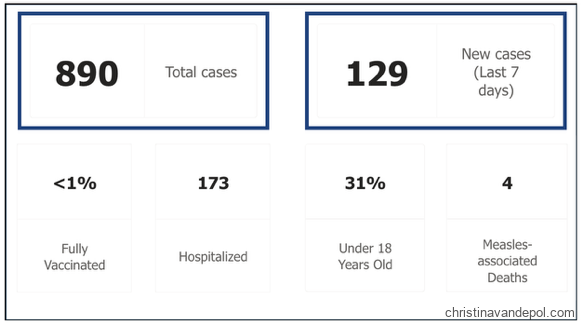
As of September 25, 2026 the PA Department of Health is still posting four measles-associated deaths on its website.
CDC has not said which Pennsylvania measles death has met their criteria.
What counts as a measles death?
There is no nationally-recognized definition of a measles death.
The PA DOH is currently using this working definition of a “measles-associated death”:
“A confirmed measles-associated death is a death that occurs within 30 days of symptom onset in an individual with clinical evidence of a measles infection and a positive laboratory test and that is not due to unrelated causes (e.g., motor vehicle accident). Additional information, such as whether an individual was exposed to measles prior to their death or supporting medical records, are also considered.”
Where does PA DOH get its death information? From death certificates completed by Pennsylvania physicians and coroners. If a doctor or coroner doesn’t suspect and test for measles or names a cause of death unrelated to measles, the PA DOH may not count that death.
So, how many measles-associated deaths have occurred in Pennsylvania or elsewhere in the United States? I don’t think we’ll ever know, but as with COVID-19 deaths or heat-related deaths, I’d wager it’s more than either the federal or state official count.
So how deadly is measles?
Lack of an accurate death count is one reason we don’t know how deadly measles is right now. But what we do know is that children, especially malnourished or unvaccinated children around the world, are at greatest risk of death from measles and other infectious diseases. And there are solutions to both of those risk factors.
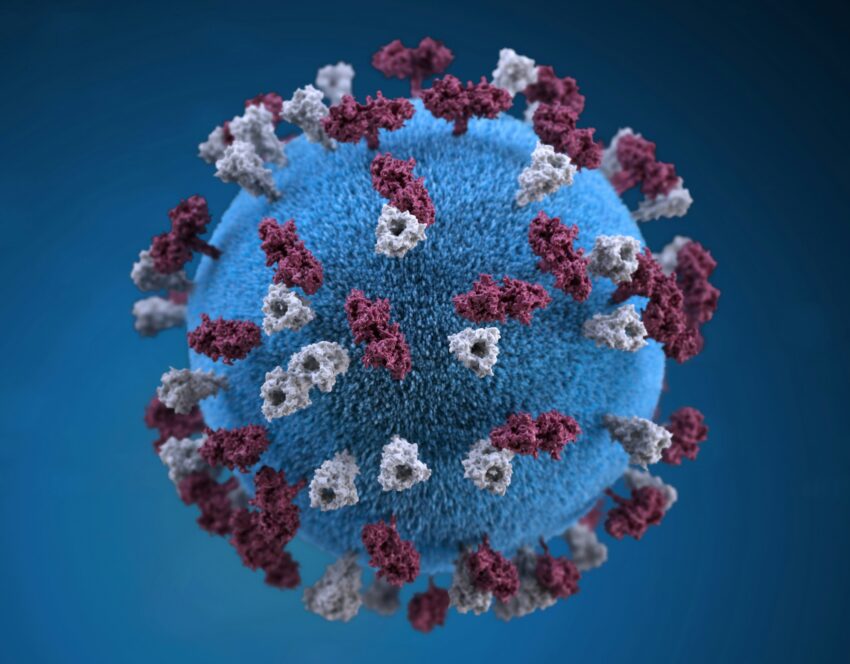
The featured image shows a 3D graphic representation of a spherical-shaped, measles virus particle studded with glycoprotein tubercles. The maroon tubercles represent H-proteins (hemagglutinin), while the gray tubercles represent F-proteins (fusion). Photo credit: CDC on Unsplash
Bibliography*
1. International Committee on Taxonomy of Viruses (ICTV)
2. Pennsylvania Department of Health Measles website
3. Centers for Disease Control and Prevention, “Interim Infection Prevention and Control Recommendations for Measles in Health Care Settings”, August 19, 2025.
4. World Health Organization, “Infection prevention and control of epidemic- and pandemic-prone acute respiratory infections in health care”, WHO Guideline, 2014.
5. Theodore H. Tulchinsky, “Maurice Hilleman: Creator of Vaccines that Changed the World,” Case Studies in Public Health. Epub March 30, 2018.
6. Sandra W. Roush, et al. “Historical Comparisons of Morbidity and Mortality for Vaccine-Preventable Diseases in the United States,” 2007, JAMA 298 (18).
7. Margot L. Savoy, “Measles, Mumps, and Rubella Vaccine”, Merck Manual (Professional Version), May 2026.
8. American College of Obstetrics and Gynecology, “Practice Advisory: Measles, Mumps, Rubella (MMR) Vaccination and Management of Obstetric–Gynecologic Patients During a Measles Outbreak,” Practice Advisory, May 16, 2025.
*In an effort to minimize text links, a bibliography of consulted resources is a new feature for blogs with significant medical science content.