
Updated June3, 2026
Deaths involving “ICE” used to prompt a mental image of someone dying of hypothermia after a fall through thin ice. But in 2026, deaths in ICE (Immigration and Customs Enforcement) custody, especially in massive detention camps, are what come to mind.
Reporting ICE deaths
The official website that reports detainee deaths says that “one of the agency’s highest priorities is detained alien health care.” Good to know. If you can’t access healthcare any other way, there’s always detainment by the federal government.
The law
The federal Death in Custody Reporting Act of 2013 applies to deaths of persons “detained, under arrest, or is in the process of being arrested by any officer of a Federal law enforcement agency.”
ICE is supposed to report “alien” detainee deaths internally within 12 hours and to the public within 90 days.
Deaths in ICE custody are increasing
Thirty people died in ICE custody in 2025, the highest in two decades.
As of April 12, ICE had reported 18 deaths for 2026. It’s immediately obvious that those reported deaths are not the whole story, because the Minnesota murders of Renee Nicole Good and Alex Pretti are not listed. Perhaps it’s a case of semantics: the 2018 Appropriations bill requires reporting the death of detained aliens, not American citizens.
[A word on semantics: ICE switched from “immigrant” to “alien” in January 2025. However, any immigrant who is a naturalized citizen or legal resident should not be included in the “alien” category as used by ICE.]
Medicolegal death investigation for deaths in custody
Coroners and medical examiners should not investigate deaths in ICE custody any differently or less thoroughly than any other death in custody.
According to NAME’s position paper on Deaths in Custody, “all deaths that occur in the custody of law enforcement, while being pursued by law enforcement, or while detained by law enforcement” are to be immediately reported to the medical examiner or coroner of that jurisdiction. The paper goes on to describe the documentation and autopsy procedures in great detail, including some—like layered neck dissection and anterior/posterior flay dissections—that may not be common in most situations.
But ICE’s website never mentions autopsies or medical examiners. “ICE notifies the next of kin, appropriate consulate, relevant DHS and ICE stakeholders, U.S. Congress and the public about each detained alien death.,” it says. But the first call should be to the coroner or medical examiner with jurisdiction over that county. Is that not happening?
Case Studies
Adelanto Detention Center – California
The ICE detainee death report for Jose Guadalupe Ramos-Solano, age 52, begins with Ramos-Solano’s criminal history and medical evaluation at the Adelanto ICE Processing Center in California. Ramos-Solano, who had diabetes, was pronounced dead at a local hospital ER on March 25, 2026. On May 28, an autopsy report obtained by Scripps News* revealed that Ramos-Solano died of COVID-19 with contributing factors of hypertension and cardiovascular disease.
I’m an endocrinologist by background. Based on the information in the death report (I haven’t seen the autopsy report), here’s my opinion about this case:
- There’s no A1C, the essential diabetes test, mentioned.
- When his glucose oscillated erratically, Ramos-Solano was treated with “sliding scale” insulin. That’s no longer standard practice. That approach may have been the cause of the wild glucose swings.
- Did a health care provider ever prescribe a GLP-1 or an SGLT2 inhibitor (now standard) for his diabetes?
- The record does not mention Ramos-Solano’s weight, BMI, or blood pressure.
- The record does not mention relevant conditions at the facility—ambient temperature, access to water, diet. Other detainees said Ramos-Solano exhibited signs of overheating. A check of the weather that day reveals high temps around 90 F for each day of the week leading up to his death.
- A doctor pronounced Ramos-Solano dead only three minutes after his arrival at the facility, suggesting he had died earlier, perhaps even at the detention center. In that case, the body should not have been moved.
The San Bernardino Sheriff-Coroner Office Death Register
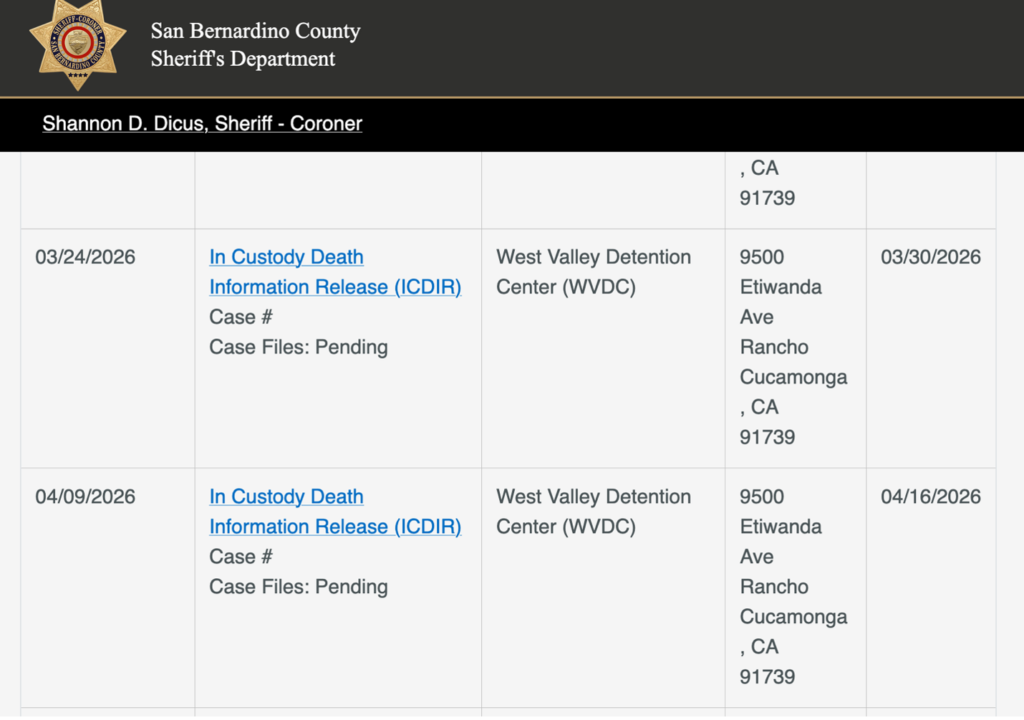
I found some answers on the San Bernardino County Sheriff-Coroner’s Office Death Register. Yes, as in many California counties, the sheriff controls the coroner death investigation function. Concerns about the inherent conflict of interest—especially for deaths-in-custody— have sparked reform initiatives, but that’s a story for another time.
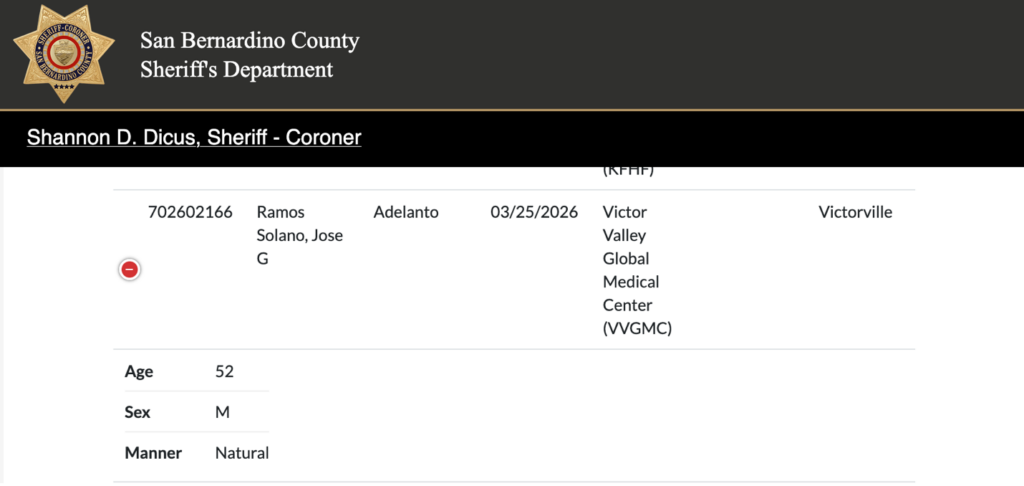
Did poor medical care contribute to this death? If Ramos-Solano had symptoms, why wasn’t he tested for COVID and other transmissible respiratory diseases. How many were exposed? And why, as of June 3, 2026, wasn’t this death’t on the Sheriff-Coroner’s In-Custody Death list?
Camp East Montana (TX) Detention Center
Three deaths at this center show how ICE’s handling of in-custody death investigations may be evolving.
The El Paso County Medical Examiner conducted autopsies on Francisco Gaspar-Andres, 48, who died in December 2025, and on Geraldo Lunas Campos, who died in January 2026.
Gaspar-Andres was hospitalized for approximately two weeks before dying of liver and kidney failure. The El Paso County ME ruled the cause of death as complications of alcoholic hepatic cirrhosis, manner of death natural.
Adam C. Gonzalez, a deputy medical examiner at the accredited El Paso County Medical Examiner’s Office, certified Lunas Campos’s cause of death as asphyxia due to neck and torso compression, manner homicide. His findings contradicted earlier claims by ICE that the death was a suicide or even due to natural causes.
ICE bypasses the medical examiner
A late March local news investigation raises questions about what happened when a third man, Victor Manuel Diaz, 36, died at Camp East Montana. ICE bypassed the El Paso County Medical Examiner—a NAME-certified, world-class ME office. Instead they transported the body to an army pathologist for examination and reported the death as a presumed suicide.
A representative at the El Paso County ME office reportedly told Randall Kallinen, Diaz’s family lawyer, that “a jurisdictional disagreement with the federal government delayed their attempt to take custody of the body.”
The family paid for a second autopsy, but as of late April, they had not released the results.
An NBC News article highlighted the puzzling change in procedure at Camp East Montana, as well as the overall reduction in information about deaths in ICE custody.
Location, location, location
The location of an ICE detention center is an overlooked factor in determining how a death-in-ICE custody case is investigated.
Coroners and medical examiners are supposed to function as independent arbiters in death-in-custody investigations. That’s what happened in Geraldo Lunas Campos’s death, largely because Camp East Montana is in El Paso County, TX. Protocol was followed and a board-certified forensic pathologist performed an autopsy. No one hid or hindered the release of the autopsy report.
As for the San Bernardino County death, we’re still waiting to find out whether the Sheriff-Coroner even ordered an autopsy before simply calling the manner of death natural.
Coming Soon: More ICE detention centers in unprepared counties
At least three detention megacenters are already in the works, and more are planned. Local municipalities, like Tremont Township in Schuylkill County, PA are concerned about water use, sewers, safety, taxes and more.
But are rural county coroner offices prepared to deal with controversial deaths occurring at a large detention center? In Schuylkill County, population less than 150,000, as in other rural Pennsylvania counties, being coroner is a part-time occupation . Until recently, the coroner’s office there brought in a contracted forensic pathologist from another county to perform autopsies in a refrigerated truck.
Walton County, GA (pop. 115,000) is the site of a planned 10,000-person ICE detention facility. Its coroner’s office is so small or understaffed, it posts no information online. Deaths at a future detention center here could be referred to the Georgia Bureau of Investigation, which performs autopsies for almost all of the state’s counties. The county’s elected coroner, however, may still have final say on what goes on the death certificate.
Counties hosting detention centers should have protocols in place with ICE concerning how a death will be handled. Investigation time, body transport, autopsies, toxicology, and repatriation or unclaimed body disposal all cost money. If these federal facilities are not paying local taxes, local officials and coroners should establish a fee structure for investigation of deaths in custody under ICE.
What coroners and MEs can do
What I wrote several years ago is still good advice. Include terms like“legal intervention” or “injuries inflicted by police/ICE/law enforcement”as the underlying cause of death on death certificates. Use the injury section to explain what happened using phrases like “killed by police” if that’s what happened. This includes “suicide by cop” cases and deaths other than shootings.
A robust and timely legal response is essential when ICE or other law enforcement tries to bypass local coroners and medical examiners. We’ll never have truth or justice if law enforcement controls death in custody investigations.
*Thanks to Scripps News reporter Patrick Terpstra for alerting me to the release of the autopsy report. This blog has been updated to include that information.