

If you’ve recently tried to find out what happened to someone from your past (and who hasn’t?), an online search may be futile. Obituaries seem to be disappearing. Or are they?
Are obituaries less common now?
Changes in population, society, and technology in the past 25 years make it impossible to determine if families are more or less likely to publicly announce deaths than they were in the nineteenth or twentieth century.
Obituaries in the U.S. became relatively common in the 1800s, but really took off when typesetting became more automated after 1900. The widespread use of print newspaper obituaries continued until the 1990s and the rise of the internet.
When my Dad died in the early 1990s, my mother personally wrote a short obituary which was published in a local paper. [Coincidentally, this is how I learned that Dad was in the Dutch Resistance during WWII, a fact neither of them had ever mentioned while he was alive. Obituaries can be a revelation.]
When my mother died in the early 2000s, I did not publish an obituary. The local paper in her community no longer existed. Online notices were not yet common practice, and Facebook didn’t exist yet. I notified the few friends and family who’d survived her and let it go at that.
Mom’s death happened during that brief period between almost-obligatory local newspaper obituaries (Dad) and today’s ubiquitous funeral home online obituaries and social media notifications.
Where are today’s obituaries?
Newspaper Obituaries
Very few obituaries are in local or regional newspapers these days unless the person is well-known in the community. Print obituaries, sadly, are becoming obsolete.
First, local papers, at least the kind that used to be essential community reading, have largely disappeared.
Second, publishing an obituary costs money. They’re expensive. According to this website, if my next of kin wants to run my obituary in The Philadelphia Inquirer the cost will be over $600. I visited Miami once or twice. I wonder if the Miami-Herald ($60+) would consider printing it instead.
Online Obituaries
Like everything else, obituaries have moved online. That’s where many of us searching for someone from our past may stumble upon the bad news. Speaking of searching, there are websites where you can sign up to be notified on your Facebook feed about obituaries in specific locations. These sites are usually “free” because of the ads for funeral homes, florists, books on grief, and more death-related businesses.
Online-only obits are less expensive, or even free if you don’t mind ads next to your story. Legacy.com, for example, can be bundled with a newspaper obituary or run on its own. I got a kick out of reading their examples of how to write an obituary. It reminded me of some creative writing classes I’ve taken: “tell a love story,” they say. Include “forward momentum.” I couldn’t get a price for an online only obit without opening an account. If you have any information on this, please comment.
Social media death notices
Social media sites are a common alternative to online obituary sites that may charge a fee to communicate a death to family and friends. The problem with this approach is that only the page owner’s contacts get the information, especially if the page is private. Real-time notification may be useful for keeping those contacts informed of funeral plans, but it’s presumptuous to think you know everyone involved in the deceased’s life. Everyone has secrets.
“Ultimately, obituaries, like funerals, are for the living.”
Obituaries: A Coroner’s Perspective
Journalists may pen obituaries for famous people, and those, like death certificates, tend to be factual.
But in most cases the legal next of kin chooses what will and will not be printed in an obituary. They get the literal last word on your life, since no one except next of kin is allowed to access your death certificate for decades.
Obituaries can lie
Next of kin can say whatever they want, including lying about your cause of death. Yes, I did see someone do that during the pandemic. The obituary stated that their spouse had died of Covid when there was no mention of it in the medical record. Why lie? Greed? FEMA paid up to $9000 for funerals of those dying of Covid. A desire for sympathy or to avoid stigma associated with the true cause of death?
Sanitized obituaries
M. H., an artist and a grandmother, had a long history of substance abuse. The heroin and morphine levels on her postmortem toxicology test were among the highest I’d ever seen. Her partner denied any drug use and became agitated when I told him the cause and manner of death that would be on the final death certificate. I don’t want her kids to see that, he pleaded. Then don’t show them the death certificate, I replied.
The public obituary the partner wrote was effusively complimentary of M.H.’s life and legacy. He did not mention drugs, mental health issues, or the cause of death. He didn’t have to, and perhaps this is all her descendants will ever see.
Often coroners see only the worst side of people—the bad habits, addictions, depressions, and poor choices that led to their death. Family knew other sides of the decedent, and naturally, want to commemorate their positive memories. As in M.H.’s case, sometimes embarrassing truths or illegal behaviors are left out altogether.
Sanitized obituaries are common, but more and more we see the opposite, especially in cases of overdose deaths. Families hoping to help others may balance their positive memories with honesty about a child’s struggles. That was the case when Zach Pettit’s family noted up front that his “addiction and anxiety disorder led to a tragic overdose, ending an incredibly bright 23 years of life.” I believe that their courage and that of others who have told the truth about a tragedy have helped save lives, contributing to the decline we now see in drug overdose deaths.
Obituaries: a window on history and society
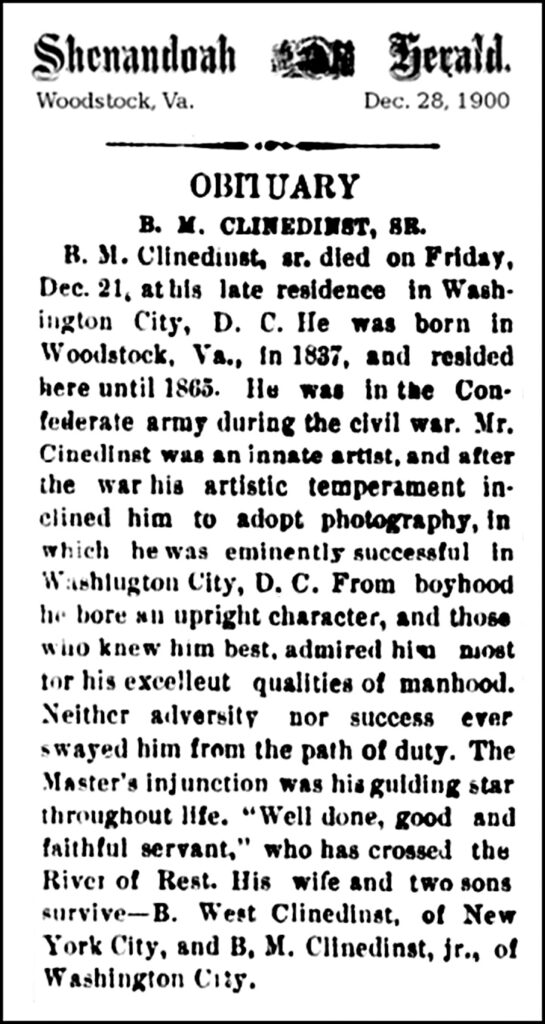
1900
This 1900 obituary of a former Confederate soldier blends history, character analysis, and reflects the values of its time: upright character, duty, and a belief in God.
I wish I could, but I can’t imagine an obit today praising someone for their “excellent qualities of manhood.”
The author of this story leaves out the cause of death and any failings Clinedienst might have had. It’s almost aspirational in tone, as if saying to its (male) readers “this, this is what you should be.”
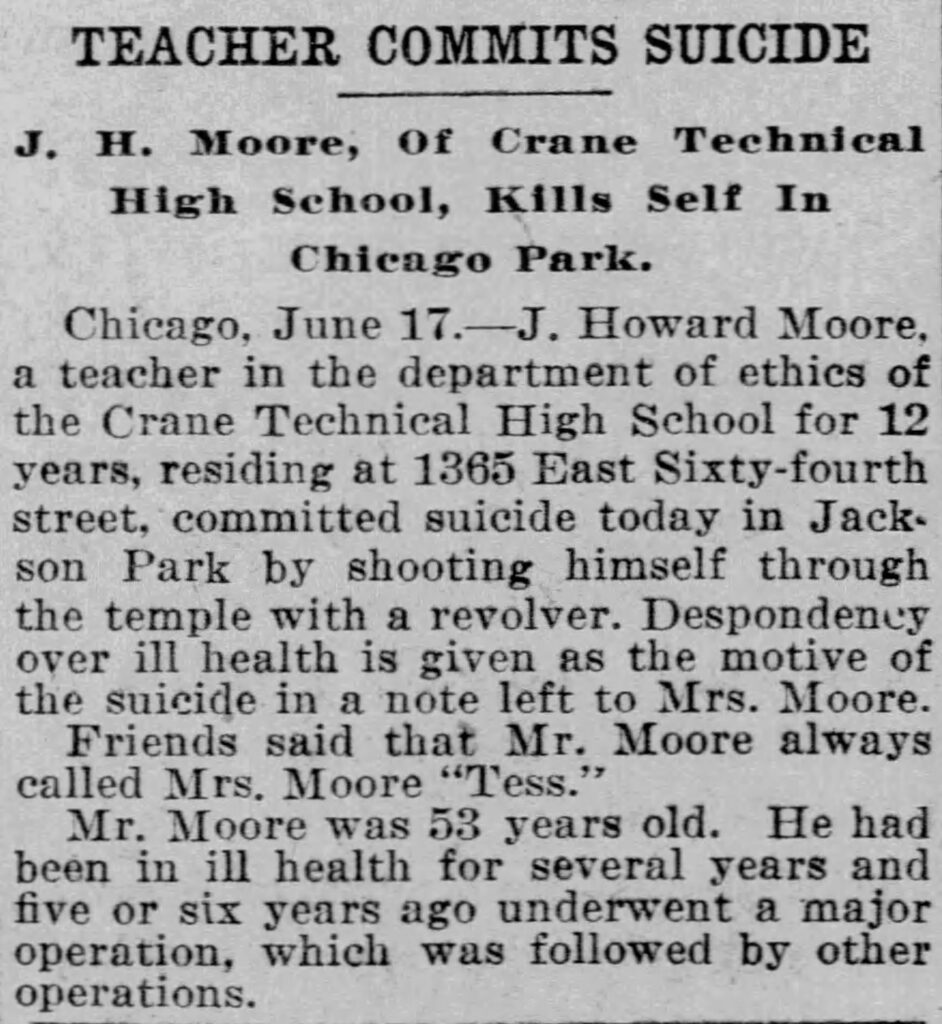
1916
The style of this obituary reads like a crime report. It’s hard to imagine this level of transparency about someone’s death nowadays. Few obituaries mention suicide, let alone reveal the contents of a suicide note.
I don’t think we have high school ethics teachers anymore either, do we?
Mr. Moore was a much more fascinating person than this story conveys. As his Wikipedia page notes, J. Howard Moore was well-known in his time, and not just because he was the brother-in-law of Clarence Darrow. The Chicago Tribune’s obituary does more justice to Mr. Moore’s story than this short summary in the Baltimore Sun.

The impact of AI on obituaries
Scraping obituary data
Since 2017, Ancestry, the online genealogy site, has been using AI bots to scrape millions of obituaries. Clearly they don’t think obituaries are obsolete, simply a new source of information. The site uses obituary data to construct or build out family trees. Of course you have to pay a fee to see those trees.
Funeral directors embrace AI-written obituaries
Sometimes family writes an obituary for a loved one, but often funeral directors collect information about a decedent—something they have to do to complete the death certificate—and write the obituary.
But why bother with a time-consuming task that AI can do in a few seconds? This 2025 Washington Post article (pay wall) describes how funeral directors are fast moving towards AI for obituaries. I don’t think AI can do the embalming or cremation yet, but who knows?
To be fair, family members themselves will probably seek assistance from AI. That might be understandable at a time of grief and stress, especially with an unexpected or violent death.
AI writes my obituary
I asked ChatGPT to write my obituary. I gave it no information whatsoever, assuming it had access to the whole internet. It took eight seconds, but it must have failed to search the internet or even this website, because it didn’t mention education or career facts or family names. No facts at all. No one reading the resulting text would know it was me. I’m sure I’m not the only person with “a dry sense of humor” or “a sharp eye for truth.” It was like a lot of other AI garbage: generic and flattering, in dire need of accurate content and ruthless editing.
Nevertheless, it was scary as hell to read that I died “peacefully at home surrounded by those who knew me best.” I wish it had named names, but I probably need the advanced version for that. ChatGPT doesn’t seem to know that if I die at home, I’ll be a coroner’s case. That peaceful serenity will soon vanish, unless “those who knew me best” can prove—fast—that I died of natural causes.
Conclusion
Obituaries are not obsolete, but they are evolving as fast as everything else in our lives (and deaths). The stories in obituaries are a mix of history and historical fiction, informed by the social values of their time. Ultimately, obituaries, like funerals, are for the living.
Featured image by Vibhu on Unsplash
3 thoughts on “Obituaries: Obsolete or Evolving?”
Thanks for this, Christine. I was noticing that obituaries for people I knew were getting harder and harder to find with each passing year. Your article explains the reasons for that. I actually met the Tarrant County assistant chief medical examiner in person a few months ago when she gave a talk at the local Rotary Club to which I belong, and it was very informative. As mentioned in a prior article of yours that I’ve read, I hope that credentials for medical examiners and coroners become more uniform in the future.
Interesting topic… I started a book about obituaries but never finished it. Did you know there’s professional organizations for obit writers? Also, they write them for famous people before they die so they have them ready.
It seems some people find it tacky to mention a cause of death in a paid death notice but I disagree. Many are boring… like who cares where someone went to high school 40 years ago… Nowadays, it seems if you use a funeral home, they’ll post an online obit if you’d like. But if they go out of business, it’s gone I guess… There’s also the website findagrave.com if you want to search for someone.
Mary, did you mean you started to write a book about obituaries? I think you should finish it! A fascinating topic that reflects so much about society. And I agree: I think it is honest—not tacky—to include a cause (and manner) of death. Thanks for your comment.
Comments are closed.